Second place at NASA’s Human Exploration Rover Challenge, plus the Phoenix Award and Best Task Tool, on a chassis 20% lighter than the previous build. I led the steering subsystem.
RISD ASTRO builds a tandem recumbent trike each year to race against college teams worldwide. Coming into this cycle the front end was the weak point: the steering assembly was significantly overweight, and bump steer made the rover wander under load — on exactly the terrain the competition is built to punish.
I owned the linkage geometry, the fabrication plan, and integration with the carbon chassis, working with Ray Liu and Wendy Tang. Cutting weight without losing precision meant treating the linkage and the layup as one problem rather than two, because every gram saved in geometry was a gram we could spend on stiffness.
credits
Team leads
William He, Jasmine He, Sarah Pine
Steering team
Adhvik Aggarwal, Ray Liu, Wendy Tang, Raul Falcon
Team members
Sasha Lee, Darren Liang
TOOLS
SolidWorks
Rhino
Carbon fiber wet layup
FDM & SLA 3D printing
Mold making
Woodworking
Clay & foam modeling
Manual machining
Fusion 360

Steering on a recumbent trike is an ergonomics problem before it's a mechanical one. The rider is reclined with their arms out in front and their weight already committed, so every dimension in the linkage has to work for the hands before it works for the wheels.


The system spans 20 inches, with 5.5 inches between upper and lower linkage. That gap does two jobs at once: it holds a neutral, comfortable grip for the rider, and it's wide enough to keep steer angle efficient with minimal bump steer. Narrowing it would have saved weight and cost us both.

So the weight came out of the material strategy instead. Carbon wet layups in one-part molds, twill weave and spread tow. Large molds printed in PETG on a Bambu H2D, small ones in Tough 2000 resin. AERO PLA inserts embedded in the layup keep parts light where load concentrates.
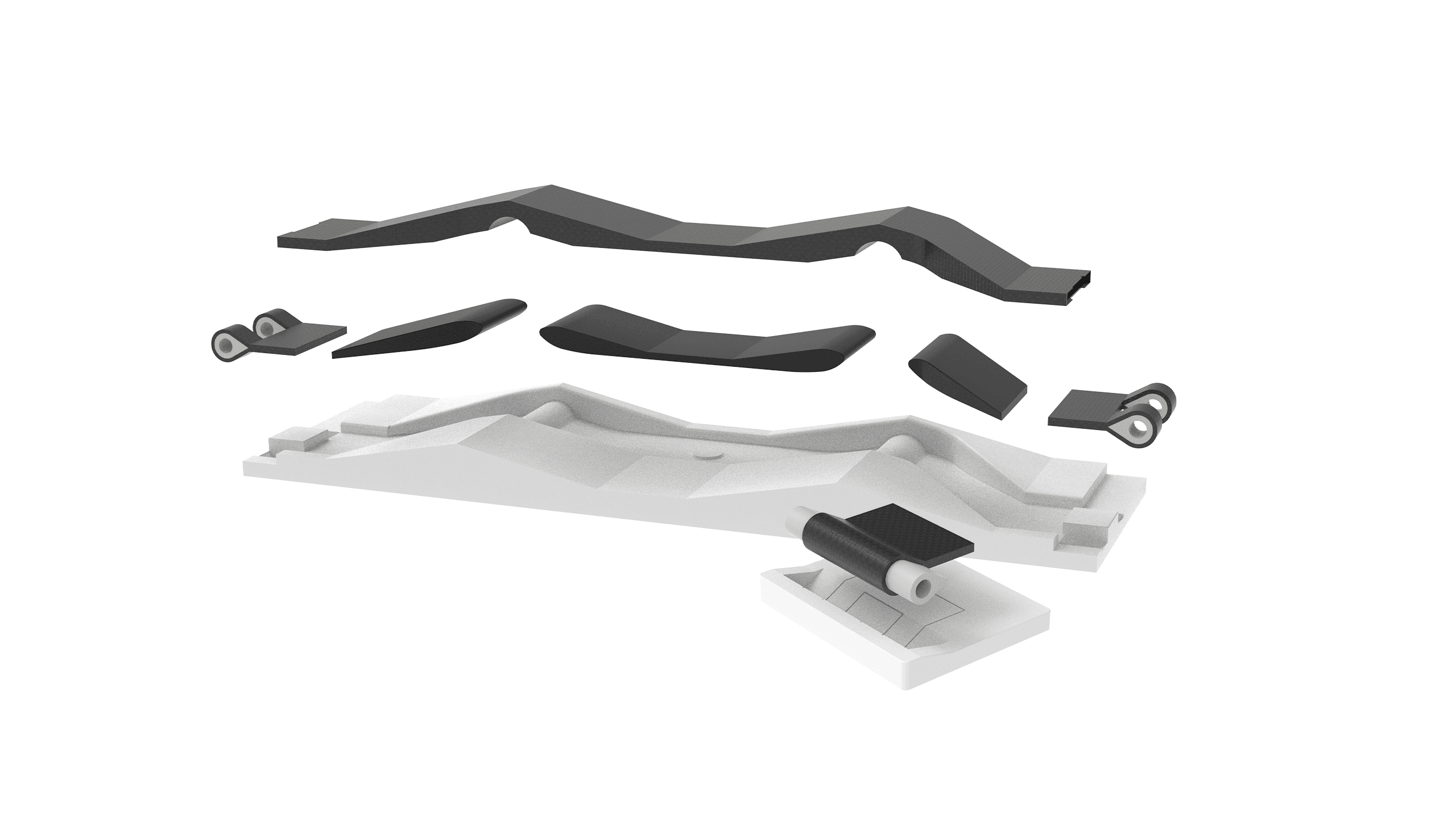


Everything that had to be metal was either made in-house or bought standard: SLS nylon bushings at the handle pivots, aluminium collars turned on the lathe, McMaster shoulder bolts throughout. Standard hardware where it doesn't matter buys time for the parts where it does.

Working in a team where designers and fabricators each owned a subsystem taught me to write for handoff — drawings, dimensions and tolerances someone else can machine without asking. The next iteration should isolate the steering column from the chassis, which would let us push steer angle further without costing the rider comfort.

