A travel pillow with no foam in it and no air in it: printed as a single lattice that crushes into a backpack pocket by hand and springs back into shape. In active development.
The travel pillow is a $400M+ global category growing 5–7% a year, with roughly 60 million units sold annually. Despite that scale it has split into two compromised camps, and stayed there for over a decade.
Foam solves for comfort: reliable neck support, no setup, holds its shape. It also takes 4–6 litres of pack volume, weighs 250–400 grams, and ends up clipped to the outside of a bag. Reviews of the top sellers land on the same complaint every time — too bulky, won’t go back in the pouch. Inflatables solve the opposite problem and fail everywhere else: under 100 grams, collapsing to a fraction of their volume, but leaks are the single most common complaint in the category, alongside slow conspicuous deployment, deflation mid-flight, and a firmness most users call inadequate for actual sleep.
Both camps assume the structure has to be something added — foam poured in, or air pumped in. NEST bets it can be the material itself, printed as a lattice: soft enough to crush by hand, resilient enough to spring back, with no separate structure to pack around or inflate.
TOOLS
Rhino
Ntop
FDM & SLA 3D printing


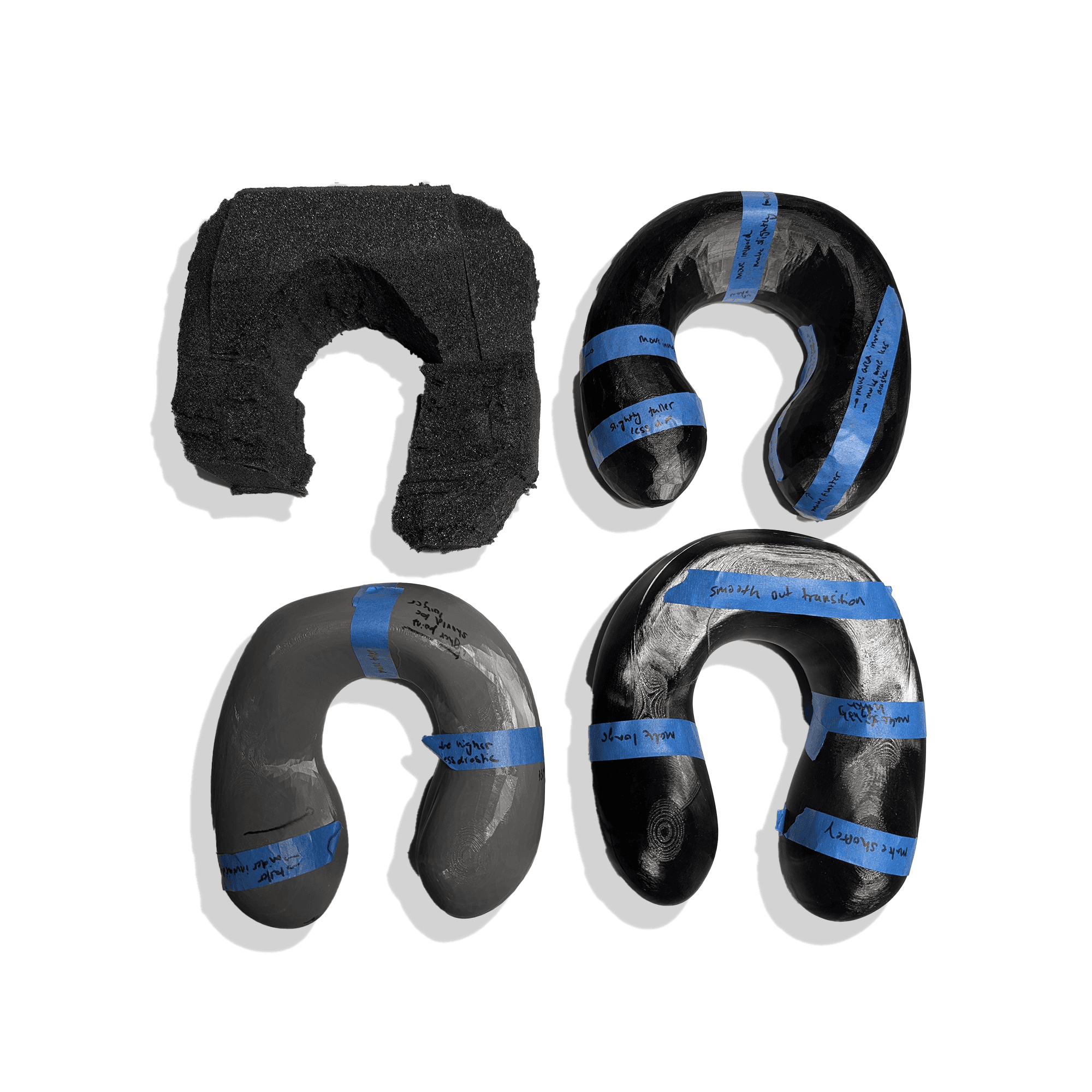
Because the lattice is generated rather than moulded, support doesn't have to be uniform. Cell density, wall thickness and geometry vary across the pillow, so it can be firm under the jaw and soft against the side of the head. Foam is one firmness everywhere by definition.

The same three variables, plus directional bias, control how the lattice responds to load. That means support and compressibility tune independently, and along different axes — the pillow can resist a head and still fold flat into a pocket.


Generated implicitly in nTop and benchmarked against slicer-native infill patterns. The differences are large: the same outer geometry can feel like memory foam or like a sponge depending on what's underneath. Current approaches use nTop lattices and variable Bambu Studio infills.

The form has stabilised; the lattice and material work haven't. Still open: the trade-off between support density and compressibility, durability across FDM and SLS prints over repeated use cycles, and which compression mechanism survives airport handling. Documentation here stays deliberately limited while the project is live.

