Forty wallpaper designs across four colour worlds for Nilaya by Asian Paints, all generated by an engine I designed and built. The collection was the deliverable. The instrument is the project.
Nilaya’s brief was a look, not a product: modern-Indian, calm, tonal, rooted. Before drawing anything I spent four days walking premium showrooms across Mumbai and Delhi — two cities, four price tiers from mass-market up — to see what was actually hanging in the category.
What almost nobody sold was craft. Not for lack of appetite, but because craft on a wall usually arrives too literally: a block print scaled up and repeated, an ikat photographed and tiled. Enlarged, not translated.
That was the finding worth having. The problem wasn’t that nobody had drawn the right pattern — it was that everyone treated craft as a motif to apply rather than a structure to read. A motif is a thing: you scale it, repeat it, and it reads as a sticker on a wall. A structure is a process, and a process holds at architectural scale because it responds to what it’s drawn from. You can draw a motif. You cannot draw a process. So the collection couldn’t start with a pattern. It had to start with an instrument.
TOOLS
Claude
FDM & SLA 3D printing
Laser cutting
KumikoComposer is that instrument. It resolves any source image into a Kumiko lattice: dense where the source reads dark, open where it reads light. It began as a single hand-painted watercolour mural — making that idea repeatable is what made it computational. Load a source. Tune how densely the weave grows, how large each cell sits, which motif fills it, how luminance maps to density, and what palette it wears. The engine redraws the source as lattice and exports production-ready art in minutes, at any dimension a wall demands. The design work sits in the mapping, not the interface. Luminance drives density rather than hue, because hue-driven density fell apart the moment a source held two colours of similar value. Cell scale had to stay coupled to output dimension, or the lattice read as texture at architectural size and as noise at sample size. Most of the build was finding where those relationships broke.
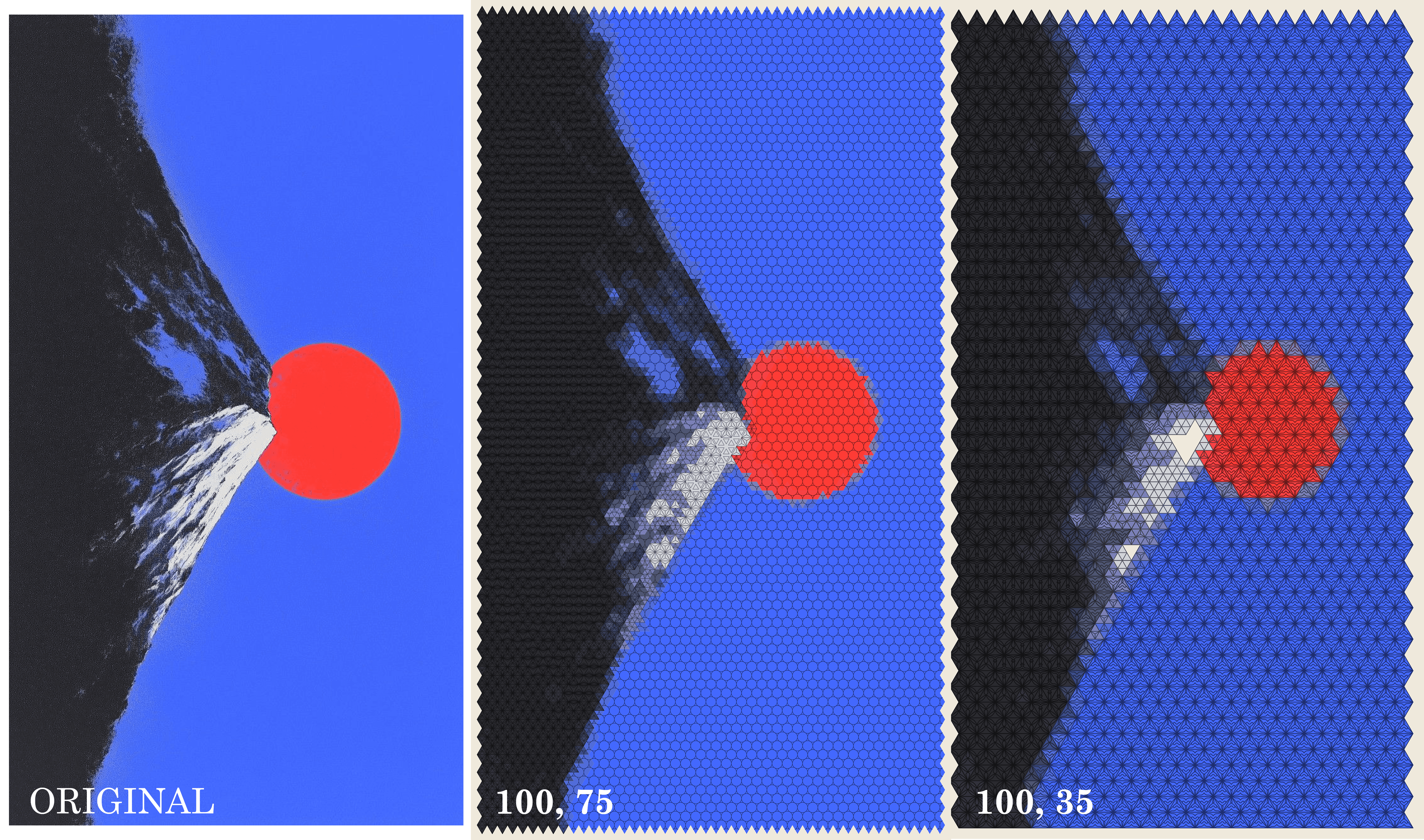
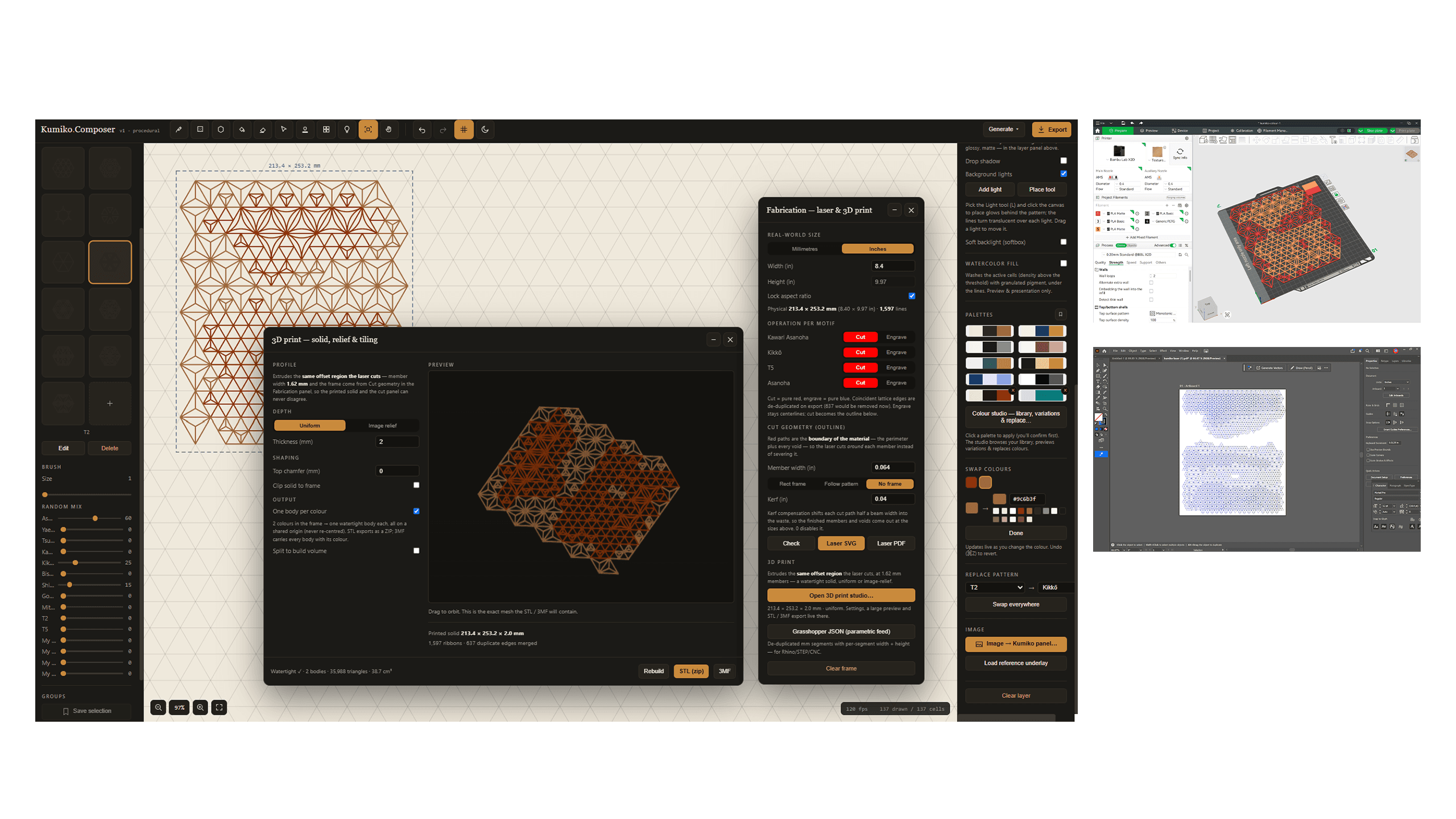

Kumiko is the Japanese art of lattice, built on an isometric triangular grid. So is the jali screen. So is the kolam. So is the structure underneath ikat. That shared substrate is the reason this works. The engine doesn't apply a Japanese motif to Indian cloth — it resolves a source into the triangular geometry both traditions already share, then draws it onto Indian textile. The method is geometric rather than decorative: a way of reading pattern, not a style borrowed from one place and applied to another.

With the engine working, the question became what to feed it. Nature is the oldest and densest source of pattern there is — the vein of a leaf, the seam of a mineral, the barb of a feather, the bleed of a dye. Prakriti samples those structures to read them, not to copy them. Forty designs across four colour worlds: sixteen neutral, eight blue, eight green and brown, eight warm. Three quarters are murals at architectural scale; a quarter are seamless repeats.


The collection is finished and moving toward printed samples. The engine isn't specific to wallpaper, though — the same lattice exports as a cut file, which makes jali screens, panels and joinery the obvious next surface. Prakriti is the first collection out of it, not the last thing it will make.

Role — Market research, tool design, engine build, collection development, art direction Built with — React, Claude Code Client — Nilaya by Asian Paints
